
Tungsten Automation : nous sommes là pour vous accompagner en vue de l’obligation de facturation électronique aux Émirats arabes unis
The United Arab Emirates’ (UAE’s) progressive economy is characterized by rapid development and a forward-thinking regulatory mindset, positioning the country at the forefront of digital transformation in the Middle East.
In this dynamic environment, UAE-based businesses are now preparing for a fundamental operational shift, as the Ministry of Finance and Federal Tax Authority move toward mandatory electronic invoicing for domestic B2B and B2G transactions. The new rules are set to roll out in stages, starting with a voluntary pilot scheme on July 1, 2026, and going fully live from January 1, 2027.
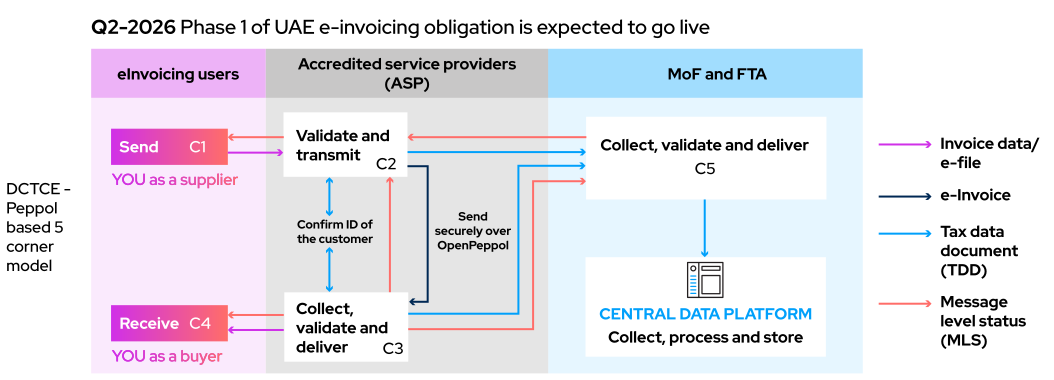
The requirements introduce a new Peppol-based five-corner e-invoicing model that uses a Central Data Platform to collect Tax Data Documents (TDD) and manage status messaging flowing between all parties. Compliance involves registration, detailed data exchange through Accredited Service Providers (ASPs), and adherence to strict data security and archiving protocols. Subsequently, finance and IT teams across the UAE’s private and public sectors should start planning for the changes immediately.
With this major transition in mind, could innovative automation and compliance solutions streamline organizations’ shift to e-invoicing?
Here at Tungsten Automation, we make it our priority to make e-invoicing as simple as possible. We provide robust solutions that take the stress out of invoice compliance, and keep your business running smoothly.
This blog provides an overview of what’s changing in the UAE, what buyers and suppliers need to know, and how platforms like InvoiceAgility can help you prepare. Read on to learn more.
UAE’s E-Invoicing Mandate Explained
The UAE is currently advancing its digital economy by launching a comprehensive e-invoicing mandate, inspired by global best practices in electronic tax compliance. In a significant regulatory move, all domestic B2B and B2G invoices issued by UAE-based suppliers must be issued and exchanged electronically in a structured XML format through an Accredited Service Provider (ASP).
As mentioned previously, the regulations are being rolled out in stages, starting with a voluntary pilot program. This pilot is set to begin on July 1, 2026, with full enforcement for early in-scope businesses starting January 1, 2027.
Higher taxpayers are included in this early in-scope group and must sign up with an ASP by July 31, 2026 and be fully compliant by December 31, 2026. Remaining in-scope businesses have until July 1, 2027, to prepare their systems but must appoint an ASP by end of March 2027. Government entities must also appoint their ASP by March 31, 2027 and and be fully compliant by October 1, 2027.
B2C invoices, as well as cross-border transactions, remain out of scope for now — although certain zero-rated and many exempt supplies must be reported via specialized commercial invoices. Certain financial, transport, and governmental activities are also excluded; see the UAE government website for more information.
Both invoice issuers (suppliers) and recipients (buyers) are required to use UAE-accredited service providers to exchange invoices in XML format, in accordance with the UAE’s evolving data dictionary of mandatory fields. Additionally, all in-scope suppliers (including non-VAT-registered businesses) must register with the UAE’s federal directory and obtain a tax identifier to comply with e-invoicing. Note that UAE requires that taxpayers use the same ASP for inbound and outbound invoices.
Businesses should also be aware that the UAE’s e-invoicing model is decentralized; meaning the Federal Tax Authority receives the transmitted invoice and tax data from both supplier and buyer, but does not validate or clear invoices. Therefore, buyers must ensure they can receive structured invoices and handle acceptance or rejection internally, as business-level responses are not fully automated through the government platform.
Structured data, residence, and retention rules also apply. All invoices and related tax data must be archived unaltered and accessible, within the UAE, for the period specified by the tax procedures law. Storing invoices outside the UAE, even in the wider GCC/EU, is not permitted under the current rules. Please see below our illustrated overview of the UAE’s e-invoicing obligations under its Peppol-based five-corner model.
E-Invoicing Compliance Challenges in UAE
As UAE businesses prepare for the phased e-invoicing deadlines arriving in 2026 and 2027, they must navigate a range of compliance challenges. These include:
- Readiness for phased implementation: Adapting to live data exchange through ASPs requires process restructuring, ERP enhancements, and timely execution to avoid operational disruption.
- Navigating evolving technical specifications: The UAE’s e-invoice data standards and data dictionary are still developing (with 50 mandatory fields and counting per invoice), possibly necessitating multiple rounds of system adjustments.
- Selecting and onboarding ASPs: Every in-scope business must identify, appoint, and fully integrate with an accredited ASP — within tight, phased deadlines. Plus, they must also ensure both their suppliers and customers are equally prepared.
- Ensuring strict data residency and archiving: Businesses are required to store all legal electronic invoices and associated data entirely within the UAE, in accordance with revised retention protocols and audit trails, incurring extra, ongoing costs, incurring extra time and business costs.
- Managing business-level response processes: Since the UAE framework does not fully automate business-level acceptance or rejection flows, companies must coordinate internal workflows across finance and IT to handle invoice approvals.
Our Future-Proof E-Invoicing Solutions for UAE
Getting ready for the UAE’s new e-invoicing rules might seem overwhelming, but you don't have to go it alone. Tungsten Automation is by your side as a trusted partner throughout your e-invoicing compliance journey.
Drawing on decades of experience in global e-invoicing, we're developing comprehensive solutions designed to help your business confidently navigate the UAE’s unique regulatory landscape.
Right now, our product management team is actively evaluating the evolving requirements and establishing full support models for the UAE’s new five-corner model, including support for Peppol-based XML invoice exchange. On top of that, we've also got you covered with the ever-expanding UAE data dictionary, so your invoices will meet all in-scope technical standards from day one.
Moreover, we make onboarding straightforward for both buyers and suppliers, helping you register for a tax ID and be listed in the mandatory directory, even if you’re not registered for VAT.
Finally, with our end-to-end invoicing automation solution InvoiceAgility, your invoices and related metadata remain safe and compliant with UAE data residency and audit requirements.
Tungsten Automation – Your Partner for Electronic Invoice Success in UAE
We know how quickly things change, so we’re committed to continuous monitoring and rapid adaptation to keep you fully prepped for the United Arab Emirates e-invoicing transition.
With seamless onboarding support and powerful automation solutions built for UAE compliance, Tungsten Automation takes the complexity out of electronic invoicing so you can focus on your core business goals.
For ongoing updates on the UAE’s e-invoicing regulations, visit our United Arab Emirates compliance resource page. Alternatively, to discuss how our solutions can support your organization, reach out to our invoicing expert team today.


Gain insights on the newest e-invoicing mandates and regulatory changes impacting global businesses. Focus on key requirements and upcoming changes in France, Germany, China, and UK.
WebinaireRessources associées

Nous contacter
Contactez un expert Tungsten Automation pour en savoir plus sur nos solutions.

Demander une démo
Grâce à une démo personnalisée, vous découvrirez comment nous pouvons vous aider à favoriser l’innovation, augmenter votre productivité et améliorer vos résultats.