
The Agentic AI Tool-Use Pattern
When we talk about “agentic AI,” one of the most important capabilities is its ability to use external tools (such as web search) instead of relying only on its internal model. This pattern is all about giving an AI system the power to reach beyond its trained knowledge whether that’s pulling fresh information, running computations, triggering business actions, or interacting with enterprise systems.
At its core, the Tool-Use Pattern treats the AI model as the reasoner, and external functions as the hands that execute tasks in the real world. Instead of hallucinating answers or guessing, the AI can decide when it needs help and then call the right tool to get the job done.

Why Does This Pattern Matter?
LLMs are brilliant at language but imperfect at facts, math, and actions. Tool Use fills all these gaps.By letting the model access a variety of tools, search engines, data systems, calculators, CRMs, image utilities, workflow APIs, the AI suddenly moves from talking about a task to actually completing it.
The more tools it has, the more broadly it can act. Modern agentic systems easily work with dozens or even hundreds of tools. Behind the scenes, the AI looks at the available options, compares them to your request, and selects the right one. When too many tools exist to pass into context, heuristics or retrieval techniques help bring only the most relevant ones into the prompt.
How does Tool-Use work?
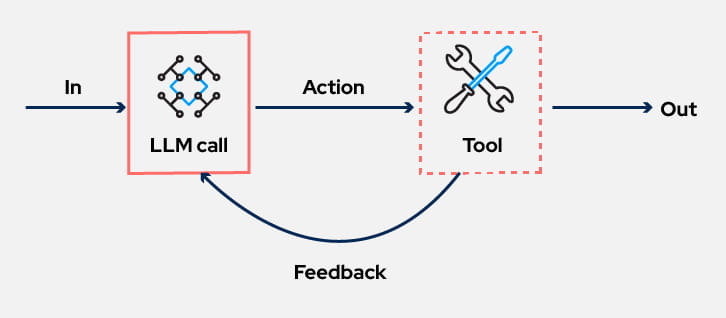
1. Input (In)
Everything starts with the user's request. This could be a question, a task, or a problem that clearly can’t be solved by text alone like fetching fresh data, running a calculation, generating a chart, or interacting with a business system.2. The LLM Thinks (LLM Call)
The model’s first job is to interpret. It looks at the request and decides whether it can answer it on its own or whether it needs help. If help is needed, the model chooses the right tool and prepares an action for it. This is where the “brains” come in and the model reasons about what to do next, not how to execute it.3. The LLM Triggers a Tool (Action → Tool)
Once the model decides on the action, it hands off a structured instruction to a tool.This might be a web service call, a DDL method, data access service, C#, .Net service or any other custom service/tool you need. In other words, the LLM says: “I know what needs to happen, but the tool knows how to actually do it.”
4. The Tool Does the Real Work (Tool → Out)
The tool executes the action exactly as instructed. Examples:- If the model needs numbers → the tool fetches real numbers
- If the model needs a computation → the tool calculates it
- If the model needs to trigger a workflow → the tool fires the workflow
5. The Result Returns to the Model (Feedback Loop)
Here’s the subtle but important part: The output from the tool isn’t the final answer it’s fed back to the model.The model then:
- interprets the result
- continues reasoning
- decides if another tool call is needed
- or returns a final answer to the user
This loop can run once or multiple times depending on complexity.
| Mathematical Reasoning | Wiki QA |
|---|---|
| In a 90-minute game, Mark played 20 minutes, then another 35 minutes. How long was he on the sideline? | Ralph Hefferline was a psychology professor at a university. In which city is this university located? |
| Mark played for a total of [20 + 35 = y1] minutes. So, he was on the sideline for [90 - y1 = y2] minutes. | Search the [university of Ralph Hefferline - WikiSearch-> y1], which is [y1 - NER-> y2]. Then find the [city y2 is in - WikiSearch-> y3]. |
| y1 = 20 + 35 = 55 | y1: Ralph Hefferline was a professor at Columbia University … |
| y2 = 90 - y1 = 90 - 55 = 35 |
y2: Columbia University y3: Columbia University is an Ivy League university in New York … |
| The answer is 35 minutes. | The answer is New York. |
Before using agentic tools, every application needed custom logic stitched together manually.
Now the logic can be driven by the model’s reasoning. The AI becomes the glue layer that links tools, data, and decisions together without rigid workflows.
That’s also why companies are starting to build internal “tool catalogs” or “tool registries” places where skills, APIs, and automations live, and the model can pick from them depending on the situation.
A broader view: this pattern sets the stage for autonomy
Even though this pattern looks simple on paper, it’s the piece that allows AI systems to grow into more autonomous roles.Once a model can:
- understand intent
- break problems down
- select tools
- take action
- collect feedback
- and continue the loop
And the more reliable the tools become, the more confidently the AI can take on tasks that used to require people such as analytics, reporting, QA checks, scheduling, research, drafting, outreach, monitoring, and more now with the help of staff can focus on higher value projects rather than giving more time to repetitive or operational tasks.
Glossary: Key Concepts Explained
| Term | Explanation |
|---|---|
| Tool-Use Pattern | An agentic AI design pattern where a model calls external tools such as APIs, databases, or enterprise services to execute real-world actions. |
| LLM Reasoning Layer | The decision-making component of an AI system that determines when a tool is required and selects the appropriate action. |
| Tool Registry | A structured catalog of available tools and services that an AI agent can access based on task requirements and permissions. |
| Feedback Loop | The process in which tool outputs are returned to the model, enabling continued reasoning, validation, or additional actions. |
| Ground Truth Data | Verified data retrieved from trusted enterprise systems that replaces guesswork and reduces hallucinated responses. |
Frequently Asked Questions (FAQ)
What is the Agentic AI Tool-Use Pattern?
The Tool-Use Pattern allows an AI model to call external tools such as APIs, databases, and enterprise services to execute real actions instead of generating text-only responses.Why can’t large language models rely only on internal knowledge?
LLMs are trained on historical data and may lack real-time accuracy. Tool-Use enables access to fresh data, verified records, and operational systems.How does Tool-Use reduce hallucinations?
By retrieving validated data from trusted systems, the AI replaces guesswork with ground truth, improving reliability in enterprise workflows.What types of tools can agentic AI systems use?
Common tools include search engines, CRMs, ERP systems, workflow APIs, calculators, analytics platforms, and internal automation services.Does Tool-Use make AI systems autonomous?
Tool-Use is a foundational capability that enables AI systems to move from conversation to action, forming the basis for more autonomous enterprise agents.Discover how the Agentic AI Tool-Use Pattern can improve your workflows with TotalAgility: request a demo now.
More in the Agentic AI Design Patterns series
This article explores one of the core Agentic AI design patterns in depth, while the rest of the series provides detailed breakdowns of the other patterns that shape enterprise-grade AI systems.

Agentic AI Design Patterns for Enterprise AI Systems
This article is part of a dedicated series exploring how agentic AI design patterns enable reliable, governable, and scalable enterprise AI agents. This post highlights how the Tool-Use Pattern allows AI agents to turn reasoning into structured, system-level action.
More in this series:
- Why building truly agentic AI means engineering the whole brain - A sharper take on agentic AI: why an LLM alone is not enough, and why memory, tools, planning, reflection, and coordination must work together as one system.
- Agentic AI Design Patterns: An Overview - A high-level introduction to agentic AI systems and the core design patterns used in enterprise environments.
- The Agentic AI Reflection Pattern - How structured self-review loops improve accuracy, reduce hallucinations, and introduce validation safeguards in enterprise AI systems.
- The Agentic AI Multi-Agent Pattern - Designing collaborative AI systems with specialized roles and orchestration logic.
- The Agentic AI Planning Pattern - How structured planning and task decomposition support long-running, goal-driven AI workflows.

Gartner® recognizes Tungsten Automation again as a Leader in the second edition of the Magic Quadrant™ for Intelligent Document Processing (IDP).
Lire le rapport
Nous contacter
Contactez un expert Tungsten Automation pour en savoir plus sur nos solutions.

Demander une démo
Grâce à une démo personnalisée, vous découvrirez comment nous pouvons vous aider à favoriser l’innovation, augmenter votre productivité et améliorer vos résultats.